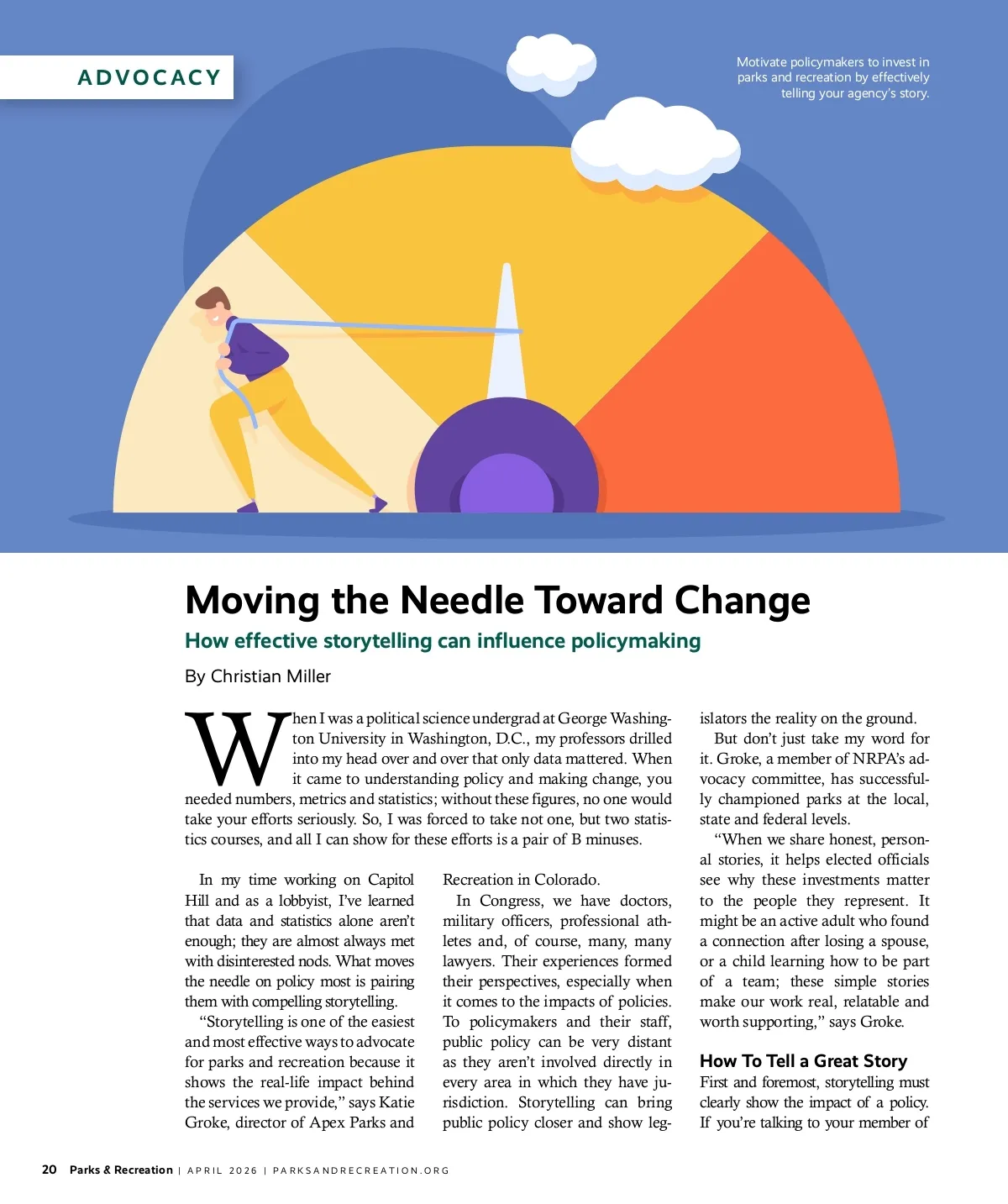
ADVOCACY Motivate policymakers to invest in parks and recreation by effectively telling your agency’s story. Moving the Needle Toward Change How effective storytelling can influence policymaking By Christian Miller W hen I was a political science undergrad at George Washing-ton University in Washington, D.C., my professors drilled into my head over and over that only data mattered. When it came to understanding policy and making change, you needed numbers, metrics and statistics; without these figures, no one would take your efforts seriously. So, I was forced to take not one, but two statis-tics courses, and all I can show for these efforts is a pair of B minuses. In my time working on Capitol Hill and as a lobbyist, I’ve learned that data and statistics alone aren’t enough; they are almost always met with disinterested nods. What moves the needle on policy most is pairing them with compelling storytelling. “Storytelling is one of the easiest and most effective ways to advocate for parks and recreation because it shows the real-life impact behind the services we provide,” says Katie Groke, director of Apex Parks and Recreation in Colorado. In Congress, we have doctors, military officers, professional ath-letes and, of course, many, many lawyers. Their experiences formed their perspectives, especially when it comes to the impacts of policies. To policymakers and their staff, public policy can be very distant as they aren’t involved directly in every area in which they have ju-risdiction. Storytelling can bring public policy closer and show leg-islators the reality on the ground. But don’t just take my word for it. Groke, a member of NRPA’s ad-vocacy committee, has successful-ly championed parks at the local, state and federal levels. “When we share honest, person-al stories, it helps elected officials see why these investments matter to the people they represent. It might be an active adult who found a connection after losing a spouse, or a child learning how to be part of a team; these simple stories make our work real, relatable and worth supporting,” says Groke. How To Tell a Great Story First and foremost, storytelling must clearly show the impact of a policy. If you’re talking to your member of 20 Parks & Recreation | APRIL 2026 | PARKSANDRECREATION.ORG
Parks Recreation Magazine April 2026: Page 20