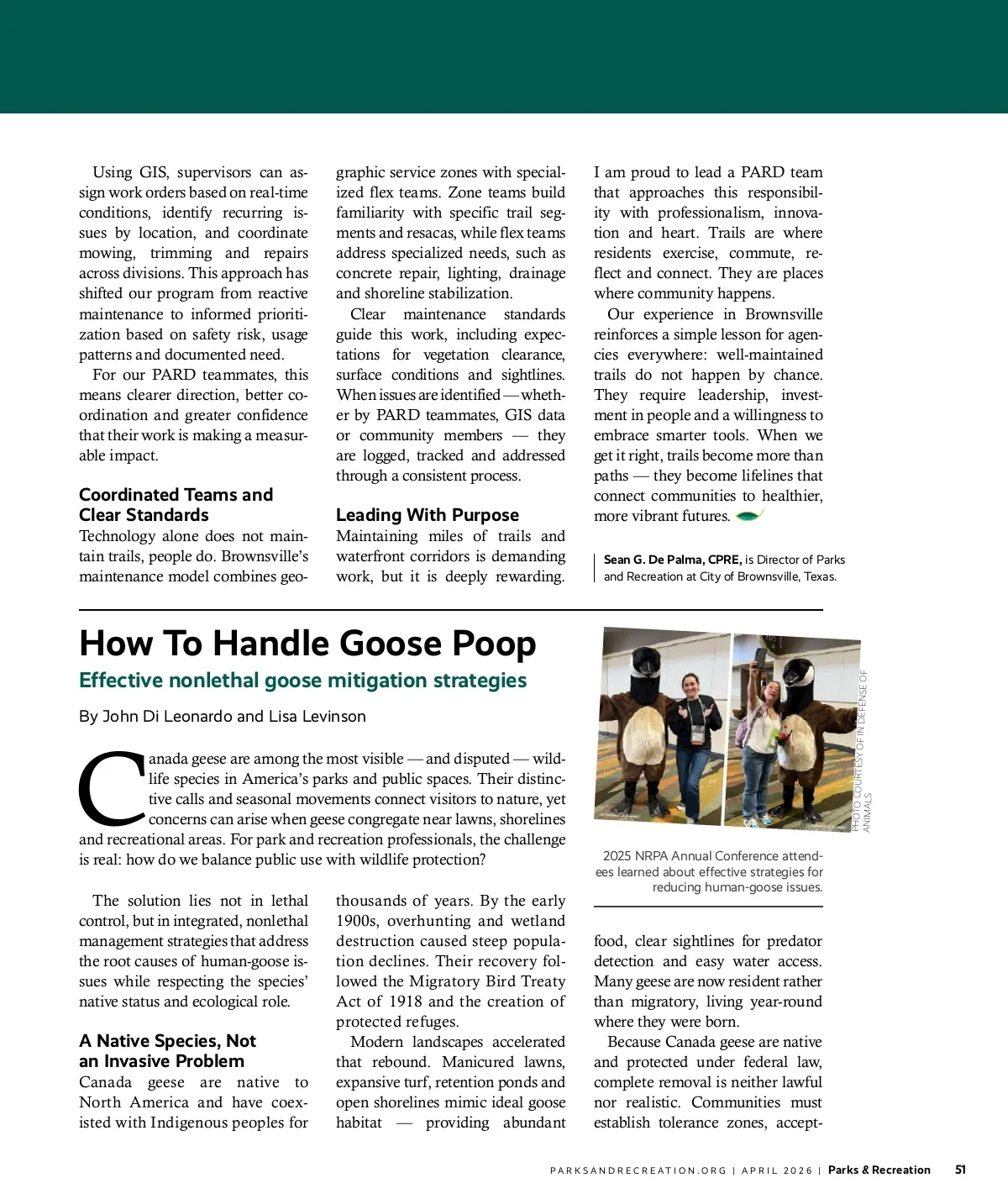
Using GIS, supervisors can as-sign work orders based on real-time conditions, identify recurring is-sues by location, and coordinate mowing, trimming and repairs across divisions. This approach has shifted our program from reactive maintenance to informed prioriti-zation based on safety risk, usage patterns and documented need. For our PARD teammates, this means clearer direction, better co-ordination and greater confidence that their work is making a measur-able impact. Coordinated Teams and Clear Standards Technology alone does not main-tain trails, people do. Brownsville’s maintenance model combines geo-graphic service zones with special-ized flex teams. Zone teams build familiarity with specific trail seg-ments and resacas, while flex teams address specialized needs, such as concrete repair, lighting, drainage and shoreline stabilization. Clear maintenance standards guide this work, including expec-tations for vegetation clearance, surface conditions and sightlines. When issues are identified — wheth-er by PARD teammates, GIS data or community members — they are logged, tracked and addressed through a consistent process. Leading With Purpose Maintaining miles of trails and waterfront corridors is demanding work, but it is deeply rewarding. I am proud to lead a PARD team that approaches this responsibil-ity with professionalism, innova-tion and heart. Trails are where residents exercise, commute, re-flect and connect. They are places where community happens. Our experience in Brownsville reinforces a simple lesson for agen-cies everywhere: well-maintained trails do not happen by chance. They require leadership, invest-ment in people and a willingness to embrace smarter tools. When we get it right, trails become more than paths — they become lifelines that connect communities to healthier, more vibrant futures. Sean G. De Palma, CPRE, is Director of Parks and Recreation at City of Brownsville, Texas. How To Handle Goose Poop By John Di Leonardo and Lisa Levinson C anada geese are among the most visible — and disputed — wild-life species in America’s parks and public spaces. Their distinc-tive calls and seasonal movements connect visitors to nature, yet concerns can arise when geese congregate near lawns, shorelines and recreational areas. For park and recreation professionals, the challenge is real: how do we balance public use with wildlife protection? The solution lies not in lethal control, but in integrated, nonlethal management strategies that address the root causes of human-goose is-sues while respecting the species’ native status and ecological role. thousands of years. By the early 1900s, overhunting and wetland destruction caused steep popula-tion declines. Their recovery fol-lowed the Migratory Bird Treaty Act of 1918 and the creation of protected refuges. Modern landscapes accelerated that rebound. Manicured lawns, expansive turf, retention ponds and open shorelines mimic ideal goose habitat — providing abundant 2025 NRPA Annual Conference attend-ees learned about effective strategies for reducing human-goose issues. A Native Species, Not an Invasive Problem Canada geese are native to North America and have coex-isted with Indigenous peoples for food, clear sightlines for predator detection and easy water access. Many geese are now resident rather than migratory, living year-round where they were born. Because Canada geese are native and protected under federal law, complete removal is neither lawful nor realistic. Communities must establish tolerance zones, accept-Parks & Recreation PHOTO COURTESY OF IN DEFENSE OF ANIMALS Effective nonlethal goose mitigation strategies PARKSANDRECREATION.ORG | APRIL 2026 | 51
Parks Recreation Magazine April 2026: Page 51